rbeyers
From http://www.anc.org.za/caucus/show.php?ID=2633
15 May 2012
Chairperson, Honourable Members, Ministers and Deputy Ministers, we are truly living in exciting times for science and technology in our country. There is an absolute hive of activity, with groundbreaking new initiatives in many areas.
In his budget speech earlier this year, Minister Gordhan identified investment in science and technology as an essential lever to achieve sustained economic growth. In partnership with science councils and institutions of higher learning, the DST has shown how innovation can substantially benefit all the citizens of our country.
The DST`s work is unique in many ways – we apply science and technology to address present challenges, but we also delve deeply into the past, and look far into the future.
Starting with the past, Honourable Members, we must remind ourselves again that South Africa has some of the richest evidence of how plant and animal life evolved and how modern humans originated.
In order to fully exploit this priceless heritage, working closely with our palaeontologists and archeologists we developed a strategy for the palaeosciences, which was approved by Cabinet in February this year. The strategy is directed at building human capital, providing resource support and enabling legislation to collect, curate and research our invaluable palaeoscience treasures, and to increase public engagement on all aspects of this exciting field of scientific endeavour.
Implementation of the strategy has already begun: a new Centre of Excellence in Palaeontology will be established next year, and two new research chairs in the palaeosciences have been awarded. One is a carbon-dating facility at UCT and the other is on the origins of modern humans, hosted by the Institute of Human Evolution at Wits University. Last month, Honourable Members, Minister Pandor unveiled the state-of-the-art palaeosciences microfocus CT scanner, funded by the National Research Foundation. Honourable Members, this scanner, the only one of its kind in Africa, can take non-invasive X-rays and provide high-resolution imaging of fossils, even if they are encased in millions of years of lime and stone deposits. This scanner will undoubtedly help to solve even more mysteries about the origins of humankind, adding to our country`s growing reputation as an innovator in this field.
However, Honourable Members it is the science of astronomy that allows us to explore the much more distant past, going right back to where it all started. Our 64 dish MeerKAT radio telescope, which will be operational in 2016, and even more so the Square Kilometre Array, will tell us more about the origins of the universe, revealing some of its secrets that we don`t yet fully understand. Astronomers from all over the world are already lining up to use these facilities. In fact, many leading researchers have already joined us here in South Africa. The SKA will, after all, be one of the biggest single global science projects the world has ever seen.
Moving to the present, Honourable Members, we are blessed with a country that has rich resources with immense possibilities. But for us to take full advantage of these opportunities we need far more young people to follow science-based careers. The DST continues to employ Science and Maths Olympiads and competitions to identify and nurture talented young people. The DST provided support to more than 13 000 Grade 10 to 12 learners from Dinaledi schools to participate in the 2011 National Science Olympiad.
South African learners continue to excel at international science competitions. At the 2011 Intel International Science and Engineering Fair, the world`s largest high school science research competition, a special award was made to a South African learner, who investigated how playing music could lead to increased productivity in factories.
We are happy to report that South Africa successfully hosted the International Junior Science Olympiad in Durban, with 43 countries participating, in December last year. In September, the South African science centre community hosted the 6th Science Centre World Congress in Cape Town, which attracted delegates from over 50 countries, including no fewer than 17 other African countries. Our science centres, which we have every intention of expanding, help to create an awareness of and an interest in science. Almost all our centres offer career guidance and curriculum support programmes such as teacher workshops. The science centres also provide an opportunity for learners who do not have laboratories, especially at rural schools, to experience the excitement of practical science experiments, while our mobile laboratories travel to schools that are far removed from the science centres.
Honourable Members, the success of our science system is strongly dependent on improved performance at school level. While technology alone will not provide all the answers, one of our challenges is to apply the available knowledge and technologies to support learning and teaching. With this in mind, the DST, working closely with the Department of Basic Education and the Eastern Cape Department of Education, has started an initiative looking at how a range of technologies can be deployed to address education-related challenges in a rural context. The chosen site for this initiative is the Cofimvaba School District in the Eastern Cape, concentrating initially on the 26 schools in the Nciba Circuit. A team from the CSIR has already conducted a comprehensive scoping exercise of these schools. The HSRC will be doing the important monitoring and evaluation work, and will assist in guiding choices of interventions that offer the best solutions to achieve better educational outcomes.
Honourable Members, climate change is probably the biggest single threat facing humankind today, and poor communities in Africa are particularly vulnerable to its effects.
South Africa has made a commitment to reduce greenhouse gas emissions. This can be done, but will require a decisive shift away from our current carbon-intensive, resource-based economy to a more resilient low-carbon, knowledge-based economy, which uses clean renewable sources of energy.
Our government`s 20-year Integrated Resource Plan sets the target for renewable energy to make up 42% of all new power generation by 2030. We know that we have an abundance of renewable energy potential in our country. We have some of the best conditions for solar energy in the world, and sufficient wind-energy potential to provide us with most of our energy needs. The DST has established research programmes based at various universities, focusing on solar and wind energy as well as on biofuels, so that we can use locally developed technologies to harness these resources. Two new research chairs have been established for biofuels research.
But, Honourable Members, it is in the area of hydrogen and fuel cell development where some of the most pioneering work is happening, and this is potentially the clean fuel of the future. We can see promising beginnings of a shift towards a future hydrogen economy. A number of car manufacturers have announced plans to start producing hydrogen-operated vehicles. South Africa`s telecommunications industry is already replacing its diesel generators, using hydrogen fuel cells for back-up power.
Most hydrogen fuel cells use catalysts made of platinum group metals. Honourable Members, South Africa has more than 75% of the world`s known platinum group metal reserves. This advantage, together with the very capable researchers at our centres of competence, places us in a strong position to seize the opportunities offered by a future hydrogen economy.
This morning we heard about progress in hydrogen fuel cell development from Dr Olaf Conrad, a director at HySA Catalysis, one of the Hydrogen South Africa centres of competence. HySA Catalysis is co-hosted by UCT and Mintek. Its goal is to provide 25% of the global catalyst demand for the hydrogen and fuel cell market by 2020. This year, they developed a very promising platinum-based catalyst for fuel cells and further tests are being carried out on this catalyst to benchmark it with those that are already commercially available.
Potential hydrogen fuel cell components being developed by the HySA centres of competence can be used for portable power applications to provide quieter and cleaner alternative sources of energy as compared to diesel generators, and a combined heat and power application to supply power and heating for domestic and commercial use.
To ready ourselves for the commercialisation of hydrogen fuel cell products, A South African company called Clean Energy has been established. It will initially market and eventually assemble and manufacture fuel cells, has been established. Secondly, an agreement is being finalised with a Norwegian partner for the commercialisation of a hydrogen storage material, which is a HySA systems patent. HySA has also developed a power management system for portable power applications in collaboration with a South African company called Hot Platinum.
Another critical present-day challenge to which the DST has responded, Honourable Members, is ensuring that our entire population has access to clean drinking water. The lack of safe water has a profound impact on the health of our poor and vulnerable communities. Recognising this, we introduced a pilot project, launched jointly by myself, the Deputy Minister of Water and Environmental Affairs, as well as the Deputy Minister of Rural Development and Land Affairs, to provide clean drinking water in six remote rural villages in the Eastern Cape, where people were collecting water from polluted rivers and streams. The project comprises the installation of solar-powered water purification units, combined with ceramic water filters provided to households. The initiative was prompted by the realisation that, although considerable progress has been made in water provision to rural communities, some villages are highly unlikely to get piped water in the immediate future owing to their remote location.
Six task teams were trained by the HSRC in hygiene and health promotion, thus ensuring that improved hygiene practices accompany the provision of clean water. A total of 1,775 households in these villages now have access to safe drinking water. Honourable Members, this initiative has once again shown how even relatively simple innovative technologies can make a difference in the lives of our people.
The second phase of this project will be piloted in Mpumalanga and Limpopo, and a baseline study has already been completed, revealing different challenges. The experiences in diverse settings will play an invaluable role in shaping decision-making on providing relief to the millions who still require access to clean water.
We are also doing important work to ensure that existing water supplies are clean. We are pleased to report that the CSIR has developed a new freshwater ecosystem atlas, which shows which rivers and wetlands need to be kept in a natural condition. The atlas content summarises the data and on-the-ground knowledge of the freshwater ecological community in South Africa, representing over 1 000 person years of collective experience. It contains 19 priority area maps – one for each water management area in South Africa.
Food security is another area in which our department has been active.
A recent good example of constructive collaboration between the public and the private sector is the framework agreement between the Nestlé Research Centre and the CSIR, announced in March this year. This partnership is directed towards researching our indigenous plant rooibos. This will come not a minute too soon, given the fact that food production has declined in sub-Saharan Africa in recent decades. We are pleased to report that no fewer than seven of the 60 new research chairs will serve the areas of rural development, food security and land reform – bringing the total of such chairs to ten.
Honourable Members, I`m sure you will all agree that there is unprecedented activity in the world of science and technology in our country. And now we are all eagerly awaiting the outcome of the Square Kilometre Array bid. If we secure this bid to host the most powerful radio telescope in the world, we will firmly cement our position as a major player on the world`s science and technology stage.
We would not have been able to make our mark without our dedicated scientists, who continue to work diligently in their respective areas of expertise. Only last month, UCT`s Professor Jill Farrant won a prestigious L`Oréal-UNESCO award in Paris for her groundbreaking research into the development of drought-resistant crops.
The University of KwaZulu-Natal`s Dr Gita Ramjee recently received the Lifetime Achievement Award at the 2012 International Microbicide Conference in Australia. Dr Ramjee has done a great service to South African science though her tireless contribution in the field of Aids prevention.
On a sadder note, I would like to pay tribute to the science journalist Christina Scott who died so tragically in October last year. The world of science is poorer for this loss.
To conclude, Honourable Members, I must say, it continues to be a privilege working under the dynamic and energic leadership of Minister Pandor, and with a committed department under the able leadership of Dr Phil Mjwara. We would also like to express our appreciation for the consistent support we receive from members of all parties in the Portfolio Committee, under the leadership of the Chairperson, the Honourable Ngcobo. We look forward to sharing with you in more detail some of the initiatives that we have merely touched on today.
– See more at: http://www.anc.org.za/caucus/show.php?ID=2633#sthash.Z42uOlWj.dpuf
Over the festive season there will be activity in the background with preparations for the visit to Cofimvaba in the last week in January and the first week in February. This will cover the remaining eight (8) primary schools funded by SAASTA.
During these visits in January/February the following activities are planned.
1) A repeat of the energy literacy program starting with the sun and the energy transfer through a dynamo, solar, wind and hydrogen fuel cells.
2) There is growing interest in the concepts of promoting further technology education through the use of Lego. These activities may be facilitated with students from local universities where possible. A trip to Johannesburg will be essential to receive basic training from Hands on Technologies.
3) There is also strong interest in the promotion of programming amongst the learners with the use of the Programmable Lego Brick (EV3). This has enormous potential to realistically display elementary programming skills to the learners in a fun way employing a robot to execute the commands. Siya Xusa is an ideal role model for learners in South Africa as he grew up in Umtata a few kilometres from Cofimvaba.
Watch this space.
The following is an internal Education Faculty News Letter Produced by NMMU.
It contains a report on the project together with the reflections of 6 NMMU Students who experienced the project in support of Dr Ron Beyers
NMMU September Newsletter 2014
(Warning Size = 10 meg)
Phase II of the project will commence in January 2015 with the completion of the remaining 8 Schools in the Nciba Circuit. This will add great value to the work initiated by the Meraka Institute.

Tech intervention for rural schools
By Kathryn McConnachie, Digital Media Editor at ITWeb.
Johannesburg, 4 Dec 2012
The Cofimvaba Schools District Technology Project is the initiative of science and technology minister, Derek Hanekom.
The Department of Science and Technology (DST), together with the Department of Basic Education and the Eastern Cape Department of Education, has launched the Cofimvaba Schools District Technology Project.
The initiative seeks to use technology-led innovations to improve teaching and learning in rural schools.
The project will initially focus on 26 schools in the Nciba Circuit and the results of the pilot will be used to form a roadmap for potential national rollout.
| Totals | 1 | 2 | 3 | 4 | 5 | 6 | 7 | 8 | 9 | 10 | 11 | 12 | 13 | 14 | 15 | 16 | 17 | 18 | 19 | 20 | ||
| School | Mvuzo | Mbudlu | Sintile | Bangilizwe | Arthur Mfebe | Khwaza | Zamuxolo | Siyabalala | Zwelibangile | Mgcawezulu | Ntshingeni | Zigudu | Zenzile | St Marks | St James | Cofimavab | Sidubipoort | Gudwana | TM Hani | Gqoboza | ||
| 18-Jun | 17-Jun | 20-Jun | 19-Jun | 28-Jul | 29-Jul | 30-Jul | 04-Aug | 05-Aug | 06-Aug | 18-Aug | 19-Aug | 20-Aug | 20-Aug | 25-Aug | 25-Aug | 26-Aug | 26-Aug | 27-Aug | 27-Aug | |||
| Gr4 | m | 68 | 13 | 23 | 18 | 9 | 5 | |||||||||||||||
| f | 66 | 21 | 13 | 18 | 9 | 5 | ||||||||||||||||
| Gr 5 | m | 71 | 24 | 18 | 15 | 9 | 5 | |||||||||||||||
| f | 70 | 21 | 21 | 14 | 9 | 5 | ||||||||||||||||
| Gr6 | m | 108 | 14 | 1 | 28 | 4 | 17 | 13 | 14 | 3 | 9 | 5 | ||||||||||
| f | 98 | 9 | 4 | 13 | 1 | 21 | 23 | 8 | 5 | 9 | 5 | |||||||||||
| Gr7 | m | 140 | 0 | 0 | 13 | 17 | 13 | 8 | 29 | 7 | 14 | 20 | 5 | 6 | 3 | 5 | ||||||
| f | 133 | 0 | 0 | 11 | 16 | 13 | 5 | 29 | 4 | 16 | 13 | 5 | 8 | 5 | 8 | |||||||
| Gr8 | m | 189 | 24 | 17 | 13 | 17 | 9 | 27 | 14 | 7 | 17 | 23 | 2 | 5 | 7 | 1 | 6 | |||||
| f | 194 | 28 | 8 | 13 | 16 | 18 | 19 | 18 | 14 | 11 | 20 | 2 | 11 | 5 | 4 | 7 | ||||||
| Gr9 | m | 193 | 24 | 13 | 11 | 17 | 12 | 25 | 14 | 11 | 12 | 18 | 8 | 8 | 3 | 5 | 12 | |||||
| f | 176 | 31 | 19 | 7 | 16 | 21 | 22 | 15 | 6 | 6 | 8 | 3 | 10 | 1 | 5 | 6 | ||||||
| Gr10 | m | 159 | 89 | 70 | ||||||||||||||||||
| f | 219 | 105 | 114 | |||||||||||||||||||
| Gr11 | m | 72 | 72 | |||||||||||||||||||
| f | 79 | 79 | ||||||||||||||||||||
| Gr12 | m | 54 | 31 | 23 | ||||||||||||||||||
| f | 87 | 31 | 56 | |||||||||||||||||||
| School Total | 2402 | 107 | 57 | 68 | 99 | 60 | 93 | 61 | 38 | 95 | 87 | 178 | 31 | 143 | 134 | 407 | 263 | 66 | 38 | 77 | 74 | |
| 39 | 20 | 102 | 65 | |||||||||||||||||||
The figures are based on the number of questionnaires gathered from the learners on completion of the demonstrations.
Please note that these figures may vary by as much as 30%. This was discovered towards the end of the project when there were discrepancies between the stated number of learners and the actual number of questionnaires gathered.This would take the total number of learners reached to over 2800 based on 2176 questionnaires gathered.
We faced the downward journey after T M Hani school taking extra precautions to navigate the rough roads. Little did we realise that we were heading for the birth place of Chris Hani. The school was surrounded with many mud walled huts which were in a poor state of repair with many being abandoned as well.
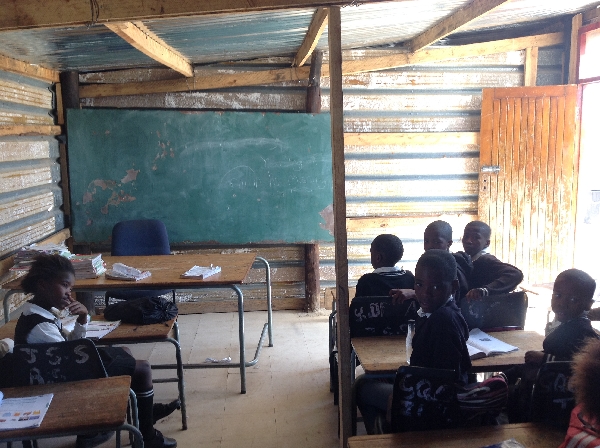
The entrance to the school lead to two brand new school buildings but there were no learners in sight. They were behind the new buildings in classrooms that were in a poor state of repair. There was evidence of an insulation layer of polystyrene but this was long gone in most classrooms exposing the learners to bare metal walls and roof with no protection in winter or summer. Huge snow storms were predicted for later in the week.
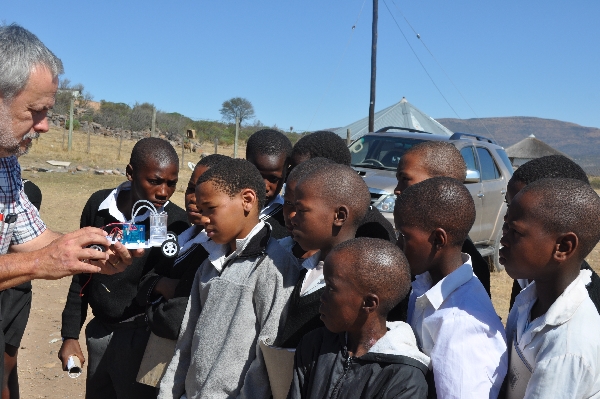
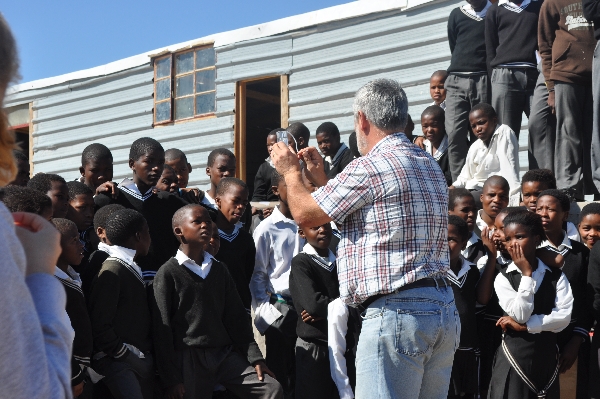
Again the right decision was taken to host the demonstration out in the open on some pretty rough ground with a group of learners standing on top of balcony outside the classrooms with the rest surrounding the table.
When we arrived there were only three teachers on the school property with the rest at various meetings for the day. Based on this fact we decided to include all learners from Grades 4 – 9 in the demonstrations.
The location afforded the opportunity to demonstrate wind energy as a light breeze had picked up. The turbine blades were soon spinning around at high speed much to the delight of the learners. The same principles that had been used at the previous school were deployed to reinforce the notion of energy transfer and the importance of renewable energy.
The teachers adopted a different attitude to the learners telling them that they had to answer the questions to avoid test at the end of the presentation. Despite this, a few learners did engage in the demonstration and I am confident that these individuals will go far in life.
On leaving the area we stopped off at the Arthur Mfebe and St Marks Schools to drop off the SD cards with the content for the Tablets.
It was a sad day knowing that all 18 schools were now complete and I will miss the friendly smiles of the learners and teachers. The spirit of Ubuntu is alive and well.
Thank you to Anglo American Platinum for the privilege of making a difference in the lives of the learners and teachers in this community.
| Gqoboza | ||||||||||||
| ### | ||||||||||||
| Grade 4 | Grade 5 | Grade 6 | Grade 7 | Grade 8 | Grade 9 | |||||||
| M | F | M | F | M | F | M | F | M | F | M | F | |
| 11 | 1 | 3 | ||||||||||
| 12 | 6 | 4 | 2 | 1 | ||||||||
| 13 | 2 | 1 | ||||||||||
| 14 | 2 | 1 | 2 | 4 | 4 | |||||||
| 15 | 1 | 5 | ||||||||||
| 16 | 2 | 4 | 2 | |||||||||
| 17 | 1 | |||||||||||
| 18 | ||||||||||||
| 19 | 1 | |||||||||||
| 0 | 0 | 0 | 0 | 0 | 0 | 10 | 8 | 6 | 7 | 12 | 6 | |
| 9 | 9 | 9 | 18 | 13 | 18 | |||||||
| 76 | ||||||||||||
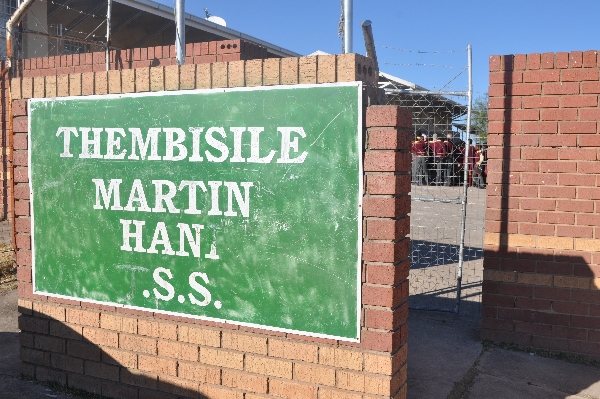
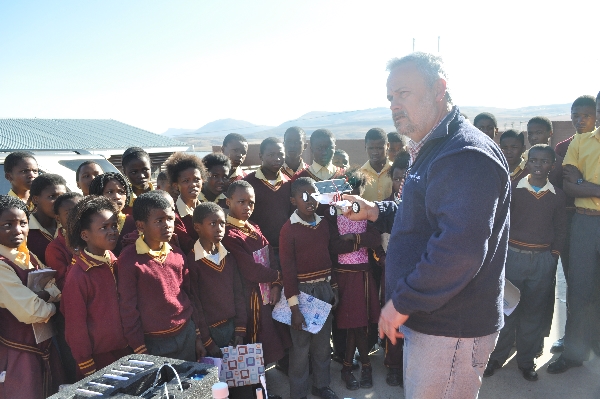
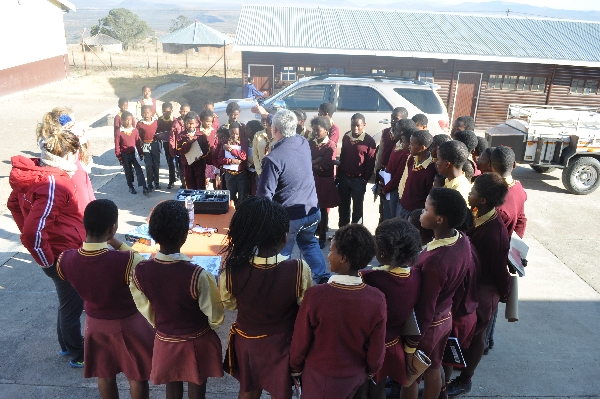
After an early start from Cathcart we made our way through the St Marks area to find the T.M. Hani School purchased on top of a hill side. A high clearance vehicle made it easier to navigate the very rough access road to the school. Having an off road trailer also ensured that the equipment arrived safely as well.
The decision was taken to do an outdoor presentation and to include the Grades 4-9 to make up a total of 75 learners as it was not a very big school. We drove in to the school grounds and within 5 minutes were greeted by the eager leaners surrounding the demonstration table.
The first few minutes of any demonstration was spent covering issues of motivation, Mathematics vs Mathematics Literacy, girls getting an education before having children, focusing on doing extra homework to improve their chances in life, etc.
The demonstration table was in half-sun which meant that the solar energy component was very easy to set up. Learners were encouraged to make observations as engineers to solve problems presented to them. One component that worked well was the use of the capacitor to capture radiant energy and to then release this in the mini car. If no energy is put in then no energy is released. The solar panel was used to capture radiant energy but this was purposely faced in the opposite direction to the sun. Again the car did not move. Some of the more observant learners (and some teachers) pointed out the problem and soon the car was working from the capacitor (stored potential energy).
This same principle was demonstrated with the hydrogen fuel cell where energy had to be put into split the water in the first place. Only then could one get energy out through the hydrogen fuel cell which worked well by releasing the car on the concrete floor and allowing it to run for quite a distance on a drop of water.
I was impressed with the enthusiasm of the teachers (7) including the answering of the questions when I posed them to the whole class – an aspect that needs further investigation. In general discussions with a teacher afterwards he reported that the lesson was very informative as they had covered that section of the work just last week. More importantly he commented on my teaching strategy which he will use in other classes.
The demonstration lasted about 90 minutes and was most enjoyable.
| Grade 4 | Grade 5 | Grade 6 | Grade 7 | Grade 8 | Grade 9 | |||||||
| M | F | M | F | M | F | M | F | M | F | M | F | |
| 8 | ||||||||||||
| 9 | ||||||||||||
| 10 | ||||||||||||
| 11 | ||||||||||||
| 12 | 2 | |||||||||||
| 13 | 1 | 2 | ||||||||||
| 14 | 4 | 1 | 1 | |||||||||
| 15 | 1 | 1 | 4 | 1 | 4 | |||||||
| 16 | 3 | |||||||||||
| 17 | 1 | |||||||||||
| 18 | ||||||||||||
| 19 | 1 | |||||||||||
| 0 | 0 | 0 | 0 | 0 | 0 | 9 | 5 | 1 | 4 | 3 | 5 | |
| 16 | 16 | 16 | 14 | 5 | 8 | |||||||
| 75 | ||||||||||||


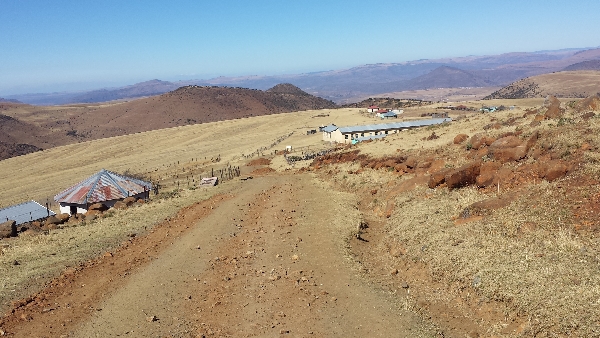
If we thought that the trip to Sudubipoort was good we soon discovered a hidden gem of South Africa. This is yet another reason why I took on this project, to see more of our beautiful country. The people of this region are so welcoming and hungry for knowledge. They are surrounded by natural beauty just outside their classrooms.
The road took us past a group of 15-20 vultures soaring around a carcass. We climbed even higher circling around so that we were able to look down on the small poort where Sidubipoort was nestled in between the mountains. What a truly magnificent experience.
We arrived at Gudwana to be greeted by an excited Principal who was expecting us. With assistance from the girls it did not take long to set up in the open air to accommodate about 50 learners in Grade 6-9. It was a challenge to interact with them with several of the learners being well above the average age. They were extremely reluctant to interact but despite this the demonstrations were completed successfully.
On leaving the school we took the road which brought us out to Khwaza School. Copies of the digital content was delivered to
- Sidubipoort
- Gudwana
- Khwaza
- Nthingeni
- Mbudlu – What a welcome. I was a long lost fiend and had to be photographed before leaving. I challenged one of the teachers to consider doing their masters degree through NMMU based on this project
- Zamuxolo
- Mvuzo – An interesting observation was the installation of a Hydrogen Fuel Cell at the school since my visit in June. The principal reported that this was from the CSIR by will be investigated further. Again the question a potential Masters degree was raised with the principal.
| Gudwana | ||||||||
| 26-Aug | ||||||||
| Grade 6 | Grade 7 | Grade 8 | Grade 9 | |||||
| M | F | M | F | M | F | M | F | |
| 11 | 3 | |||||||
| 12 | 1 | 2 | 3 | |||||
| 13 | 1 | 1 | 3 | |||||
| 14 | 3 | 4 | 2 | 1 | ||||
| 15 | 1 | 3 | 1 | |||||
| 16 | 3 | 1 | ||||||
| 17 | 2 | |||||||
| 18 | 3 | |||||||
| 19 | ||||||||
| 3 | 5 | 6 | 8 | 7 | 5 | 3 | 1 | |
| 8 | 14 | 12 | 4 | |||||
| 38 | ||||||||


After an early start from the farm we decided to stop off in the St Marks area to await instructions for the day. This came through just after 8:00 and we proceeded to Cofimvaba first to find a dirt road that was the start a journey that was certainly one of the most memorable trips of all the school visits for me. It was close to 4×4 roads despite small sedans coming down the road towards us.
We crawled in first gear on many occasions passing many children waving at us from other schools and huts. The further we went the higher we climbed necessitating more and more stops to take in the breath taking views of the area. At one point we started to descend with a vulture flying past us at eye level. Everyone was so excited at these events and the anticipating grew as we entered the poort to find a small school nestled in a very small community. The quality of the houses indicated a lower income relative to the other communities but this did not detract from the warm welcome that we received.
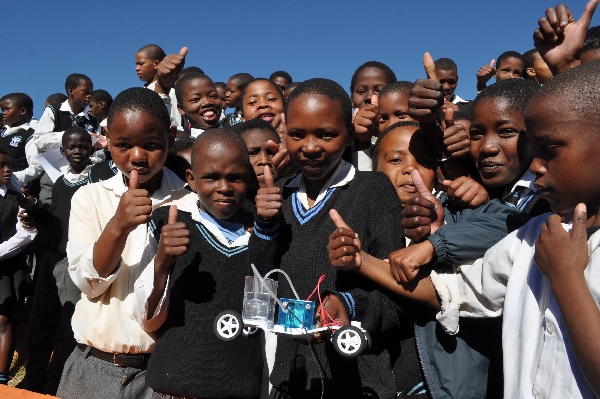
The decision was taken to host the demonstration in the open air once again to facilitate greater interaction rather that the traditional classroom demonstrations. The table was arranged so that it was half in the sun and half in the shade to facilitate the solar demonstration. This time all demonstrations were completed and all aspects of the demonstration were interlinked with the Hydrogen Fuel cells.
Key points from this visit include the fact that some of the university students had not seen a long drop as a toilet in the past and went to view one out of interest. The principal also noted that this was the first time that many learners had seen a “white” person in this community which fascinated the learners. The girls also reported that they were not accustomed to the learners touching their hair to see what it felt like and yet they created quite a stir when they moved around to see the school after the demonstrations.
Wherever there is a camera one is mobbed by excited learners keen to get their pictures taken. It is something special to see and experience first-hand the joy in the faces. This continues to create mixed emotions for me every time I go into a school of this nature.
| Sidubipoort | ||||||||
| 26-Aug | ||||||||
| Grade 6 | Grade 7 | Grade 8 | Grade 9 | |||||
| M | F | M | F | M | F | M | F | |
| 11 | 3 | 3 | ||||||
| 12 | 6 | 5 | 1 | |||||
| 13 | 3 | 3 | 3 | |||||
| 14 | 1 | 2 | 1 | 2 | 3 | |||
| 15 | 1 | 2 | 2 | 3 | 2 | 3 | 4 | |
| 16 | 1 | 2 | 3 | 3 | ||||
| 17 | 2 | 1 | ||||||
| 18 | 1 | |||||||
| 19 | ||||||||
| 14 | 8 | 5 | 5 | 5 | 11 | 8 | 10 | |
| 22 | 10 | 16 | 18 | |||||
| 66 | ||||||||


This time I was accompanied by Kim, Bonny, Roxanne and Lauren – 2nd year pre-service teachers from NMMU. We stayed on a farm outside Cathcart and travelled through to Cofimvaba arriving just after 08:00. As per usual we waited from further instructions from Mr Mgijima from the Cofimvaba Education Department. The first SMS indicated that we were to proceed to St James in the town itself which meant that we could arrive just after 08:15.
On arrival we joined in the morning assembly for the school which was a very orderly affair run by the Principal, a Sister from this Catholic run school. On meeting the Principal I got the impression that discipline in the school was very strict and that the learners reciprocated with respect to all teachers and visitors. The learners had to remove their shoes to enter certain venues, including the computer room and library.
After explaining the purpose of the visit we agreed that the demonstration would take place in the open air below a raised bank in the school courtyard as there was no venue to host a large group of over 200 learners in Grade 10. This was to prove to be the right decision as it clearly demonstrated the importance of alternative energy to the learners. It included a clear demonstration of solar and wind energy as precursors to the Hydrogen fuel cell demonstrations which built on the concepts that were developed in the minds of the learners.
The concept of storing and transferring energy was being refined with each demonstration where the learners were actively engaged at close quarters. This included affording some learners to hold the apparatus during the demonstrations adding a different dimension to the process.
A further combined Grade 11 and 12 session added a further 200 learners to the second session which highlighted the deputy head boy as being an exceptionally talented individual who will go far in life. The downside of large groups is that it is not possible tag the talented individuals as they disperse to complete the questionnaires. There was also no guarantee that all the questionnaires would be returned.
| St James | ||||||
| 25-Aug | ||||||
| Grade 10 | Grade 11 | Grade 12 | ||||
| M | F | M | F | M | F | |
| 15 | 8 | 29 | 2 | 1 | ||
| 16 | 39 | 48 | 2 | 15 | 5 | 6 |
| 17 | 23 | 19 | 32 | 36 | 13 | 19 |
| 18 | 17 | 8 | 26 | 20 | 4 | 3 |
| 19 | 2 | 1 | 10 | 7 | 4 | 2 |
| 20 | 4 | 1 | ||||
| 21 | 1 | |||||
| 89 | 105 | 72 | 79 | 31 | 31 | |
| 194 | 151 | 62 | ||||
| 345 | ||||||
| Added | 58 | 44 | ||||
| 403 | 106 | |||||
| 509 | ||||||