
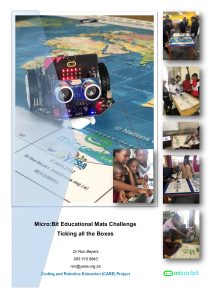
Micro:Bit Educational Mats Challenge
Ticking all the Boxes
Coding and Robotics Education (CARE) Project
Deploying the Micro:Bit Educational Challenge into South African schools has highlighted numerous issues related to high-level motivations, aligning with educational goals, technological advancement, and societal development. Some key reasons include:
Promoting Digital Literacy: Micro:Bit Educational Challenge includes a hands-on approach to learning programming in the context of education in the classroom by enhancing students’ digital literacy skills and preparing them for future careers.
STEM Education Enhancement: The program serves as a delivery vehicle for teaching Science, Technology, Engineering, and Mathematics (STEM) subjects, through encouraging learners to apply theoretical concepts, fostering a deeper understanding of these subjects and potentially inspiring future STEM professionals.
Lowering the barrier of entry into Coding. The curiosity of the learners is encouraged through initially introducing them to block-coding. Once the principles have been established they are encouraged to transition to text-based coding in Python and other languages.
Encouraging Problem Solving and Creativity: Working in teams to solve different challenges fosters creative problem-solving with the application of coded solutions to drive the Bots using the Educational Mats.
Fostering Innovation and Entrepreneurship: Using the Micro:Bit as a standalone device encourages new projects, prototypes, and solutions, through testing existing projects and sparking their own solutions, potentially contributing to the growth of a local innovation ecosystem.
Addressing the Digital Divide: Access to technology in advantaged and disadvantaged schools can level the playing fields as it provides opportunities for individuals from diverse backgrounds to have equal opportunities to acquire digital skills and potentially engage in the digital economy.
Preparation for Industry 4.0: South Africa needs a trained work force to cope with the demands of automation, connectivity, and smart technologies as part of Industry 4.0. Exposing learners to concepts like Internet of Things (IoT), coding and automation, leads to aligning their skills with the evolving needs of the job market.
Global Competitiveness: The vision is to export the Micro:Bit Educational Challenge as a global phenomenon in order to demonstrate that South African learners have the right aptitudes and attitudes to compete with their peers. Giving our youth the competitive advantage will ensure that they have the skills to use emerging technologies and compete in the open market place.
Community Engagement and Collaboration: Working in teams is a critical life skill as it encourages collaboration, communication, sharing ideas, and a sense of community.
Teacher Professional Development: Teachers are encouraged to revisit their own pedagogies especially regarding project-based learning. This project provides an opportunity for teachers to gain confidence in teaching technology-related subjects, ensuring a more holistic approach to STEM education.
Cultural Relevance: The approach to the development of Educational Mats has always been to draw on broader issues as well as to enhance pedagogical content knowledge. Teams interact with the context of the Mats and develop the code to achieve the challenge while reflecting on the visual and textual information inherent in the themes, allowing them to see the practical applications of technology in addressing issues relevant to their communities.
The inclusion of Micro:Bit Educational Mats is a way circumventing the rote learning of Coding when applied to Robotics in South African schools as it aligns with the broader goals of enhancing education, fostering innovation, and preparing students for the demands of the modern world. Most important of all, it is engaging and leads to learners having fun in a stimulating educational environment.
 PDF Version of this document
